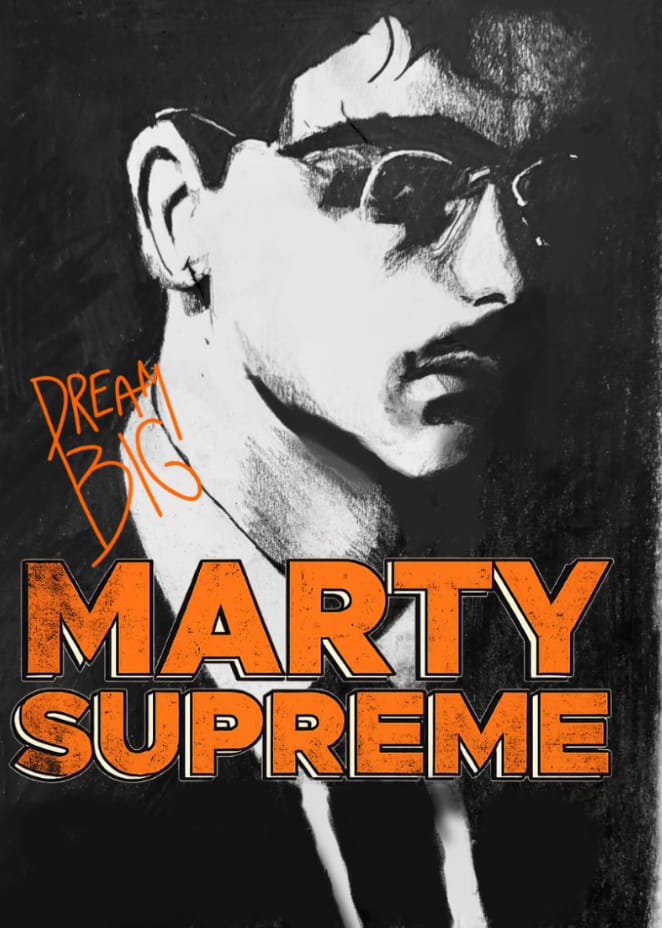
In the basement of an ordinary 1950s Manhattan social club, amidst a cloud of cigarette smoke and the rhythmic “clack, clack, clack” of a white, plastic ball, is where a skinny mustached guy spends his night. But A24’s Marty Supreme, directed by mastermind Josh Safdie, isn’t the typical “feel bad for the underdog” sports story. Instead, the cinematic masterpiece is led by the manic, transformative Timothée Chalamet, who portrays the life of Marty Mauser, inspired by the iconic ping pong player Marty Reisman. In Marty’s world of ping pong, he isn’t quite so popular. But it turns out, it’s all that people can talk about–within weeks of its release, the film grossed $58 million worldwide, officially surpassing Safdie’s previous hit, Uncut Gems, and becoming one of A24’s highest-grossing films ever. And with Chalamet recently securing a Best Actor win at the Critics’ Choice Awards and Golden Globes, people are left wondering how Marty Supreme managed to capture the attention of millions.
As soon as I saw UK rapper EsDeeKid pop out in his music video for “4 Raws (Remix)” and jam to Timothee Chalamet’s verse about Marty Supreme, I knew what my plans were for Christmas day.
Watching Marty Supreme in a reclined seat at the Pasadena Paseo Regal Theatre with a bucket of buttery popcorn in my lap gave me anything but a sense of comfort. The film focuses directly on Marty’s rushed life; the camera zooms in on the sweat trickling down his forehead, the paddle is blurred with the speed at which he hits each ball, and every ping pong match seems like a life-or-death battle. During the almost three-hour film, my eyes were glued to the screen, and my heart was racing, stressed for Marty. When the end credits finally rolled, I don’t think I’ve ever felt such relief in my life. As a Chalamet fan before the movie, Chalamet is notably playing a different character than his stereotypical “pretty boy” roles from Little Women or Call Me By Your Name. In Marty Supreme, he becomes an egotistical, overly ambitious, reckless man who you automatically hate after he blows off his friend, Rachel Mizler (played by Odessa A’zion). If I knew Marty Mauser in real life, I’m sure I would hate him too. I found myself clinging onto the arm rests, anxious to see if Marty would be caught for each crime he’d committed, and praying he would win his match against his rival, Koto Endo (played by Koto Kawaguchi). Equally shocking was seeing Shark Tank host Kevin, as well as the return of actress Gwenyth Paltrow, and of course, Tyler the Creator on the big screen. I’m not a huge movie fanatic who stalks each awards show, but I’d definitely rate the supporting cast a good 9/10, even though many of them were acting for the very first time.
*SPOILERS AHEAD:*
Although Safdie reported having a clear message in mind for the movie, viewers seem to have varying interpretations. Marty, in particular, is difficult to read as anything resembling a positive role model. He is consistently portrayed as a heartless and money-hungry man–getting married women pregnant, threatening violence for money, abandoning relationships to chase his dreams, and exploiting every single person who helps him. Even as his actions become even more destructive, such as scamming others, betraying his best friend, resisting arrest, and ultimately prioritizing his ego over actually achieving his supposed dream of becoming the best ping pong player, Marty rarely faces consequences that lead to genuine reflection.
But what is very clear is that as the movie progresses, the “supreme” factor of Marty’s talent quickly fades. And as the song “Everybody Wants to Rule the World” by Tears for Fears plays into the credits as Marty cries in reaction to his baby, people believed that it meant that Marty had finally embraced fatherhood and responsibility, signifying a new emotional shift. People widely think that Marty has finally accepted his fate and unglamorous life. Conversely, others believe that the ending means Marty has found a new ambition –raising his son.
Dangers of the Film:
As more and more people continue to watch the movie, more and more are falling into what I’ve seen as the “Sigma Trap.” The “Sigma Trap” refers to an online glorification of narcissistic characters that reject social hierarchies. Most portray toxic and misogynistic characters just like Marty Mauser himself. On TikTok, some teenagers around the age 14-15 idolize Marty’s story, believing Marty’s “grind” to be the best in ping pong is inspirational. There is nothing wrong with admiring his ambition, but as they fight to defend this character, young men are simultaneously excusing his recklessness, specifically citing the examples of impregnating Rachel and then abandoning her to demonstrate a symbol of a man who “puts his mission first.” Instead, the movie should be seen as a sharp critique of toxic masculinity.
Marty’s success is measured by the attention, money, and control he receives from the people around him. In addition, his vulnerability is treated as a weakness. For example, he avoids accountability, dismisses emotional responsibility, and repeatedly abandons his lover, Rachel Mizler, especially after she questions his independence. Even ping pong, a sport that requires precision, becomes a violent “proving” ground where every match is a test of his ego. It’s interesting to me how Safdie emphasizes toxicity in Marty by never rewarding the character with growth. He ends up constantly chasing validation like another woman, another scheme, another small victory. His toxic masculinity traps him in a cycle of self-destruction, which warns against a cultural narrative that glorifies obsession and excuses harm to others. So despite the appraisal of Marty for choosing responsibility, we need to be cautious of what lesson we are picking up from.
Whether you walked out of the theatre with a horrified look on your face or a sense of newfound motivation for ping pong, there is no denying that Safdie and Chalamet certainly hijacked the cultural conversation, leaving audiences with lingering questions about their relatability with Marty.