For millions of people around the world, the new year doesn’t begin on January 1st, but rather an annually changing date marked by a Lunar Zodiac. Lunar New Year, also known as the Spring Festival, is a widely celebrated holiday across East and Southeast Asia. The holiday begins on the first day of the first month of the traditional lunisolar calendar and spans fifteen days. It follows a twelve-year zodiac cycle in which each year is represented by one of twelve animals that are often used to determine personality traits. The representative animal of that year is also featured in decorations, merchandise, and auspicious phrases based on phonetic resemblance.
Due to the vast scope of this tradition, Lunar New Year is celebrated differently across regions. Even within China, customs in the north differ from those in the south. One of the most important days is Chuxi, or Lunar New Year’s Eve. In northern China, families gather to make dumplings (jiǎo zǐ) together. The cold and snowy northern climate makes these piping hot pockets a seasonal staple. Shaped like ancient gold ingots, they act as a symbol of wealth and prosperity. Some families even place cleaned coins inside a few dumplings, and whoever eats the “lucky dumpling” is said to receive extra good fortune in the coming year.
In southern China, Chuxi is celebrated with a large reunion dinner featuring ten elaborate dishes. The number ten symbolizes fullness and completeness, representing a year without lack. Common dishes include fish, chicken, vegetables, and crab. Fish (yú) sounds like the word for excess or surplus (duō yú), a homophone expressing the wish to have more than enough in the new year. Chicken (jī) is also significant as it sounds like the term for luck (jí lì). It is often served whole, including head and feet, to symbolize unity.
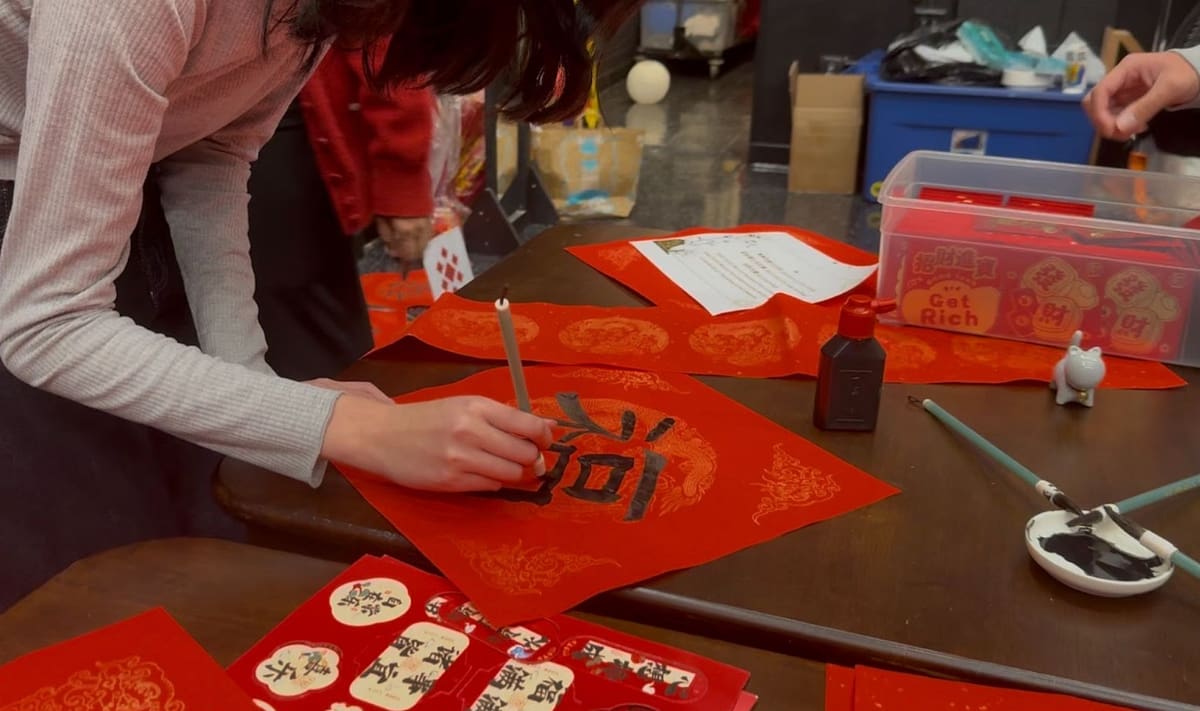
Colors and sound are the heartbeat of the celebration. According to a Chinese legend, a mythical beast named Nian would emerge every New Year’s Eve to terrorize villages and harm crops. Eventually, people discovered that Nian was afraid of the color red, fire, and loud noises. To this day, every Chuxi, fireworks are launched, glowing lanterns fill the streets, and loud drums are banged. Today, this legacy can also be found in the red paper cuttings of the word 福 (fú), fortune, which are hung upside down on front doors. These are placed upside down because the word for upside down (dào) sounds identical to the word for arrive (dào), a linguistic signal that fortune has arrived home.
During January and February, the Asian American Association hosted several events to promote Lunar New Year through artistic and cultural activities. These events included lantern-kit making, zodiac crafts, and a celebration featuring traditional Chinese instruments performed by students paired with cultural food. Zoe Huang ‘27 performed on the hulusi, a traditional Yunnan province gourd flute, while Angela Yu ‘26 played the guzheng, an ancient plucked zither. Under the guidance of Ms. Qing, the mandarin teacher at Prep, students learned to write Chinese calligraphy on New Year couplets. There was also a storytelling of how the twelve zodiac animals earned their places in the cycle. Tables were bursting with food from egg rolls and barbeque pork buns to almond cookies and Yakult. Leona Berzon ‘29 shares, “It was awesome to see how many people were there to try food, make decorations, and watch the performance. My friends and I had a blast. Our favorite part was the calligraphy writing where I taught my friend how to write 福 (fú).”
The AAA leaders and faculty worked hard to put this event together, sharing Asian culture through activities, food, and music. While Lunar New Year follows long-standing customs, the way it is celebrated continues to evolve, especially in diaspora communities where traditions blend. Despite these differences, the core meaning of this celebration remains constant: honor ancestors, reunite with family, and welcome a year of blessing.
Common Homophones
Apple (píng guǒ) – Peace and safety (píng ān)
Tangerine (jú zi) – Auspicious and lucky (jí lì)
Persimmon (shì zi) – Success and fulfillment of desires (shì shì rú yì)
Lettuce (shēng cài) – Rising wealth (shēng cái)
Rice cake (nián gāo) – Higher, better year (nián gāo)

![Class of 2026 Takes Part in a “[F]antastic” Game of Senior Assassins](https://mlluv3biwjhe.i.optimole.com/w:1018/h:654/q:mauto/f:best/https://theflintridgepress.com/wp-content/uploads/2026/05/Screenshot-2026-05-05-at-8.47.44-AM.png)