Between discussing the Schrödinger equation and encouraging students to see factoring as a puzzle, Ms. Christensen, Prep’s new Honors Chemistry and Algebra II teacher, brings enthusiasm, inclusivity, and entertainment to the classroom.
Ms. Christensen was first introduced to the Prep community as a long-term sub last spring, where she found the science department to be full of people “who are really fun to work with,” and students to be “friendly, great, and high-achieving.” This environment, filled with motivated and intelligent students who are able to talk about the subject in depth, made it easy for her to have a good time in the classroom.
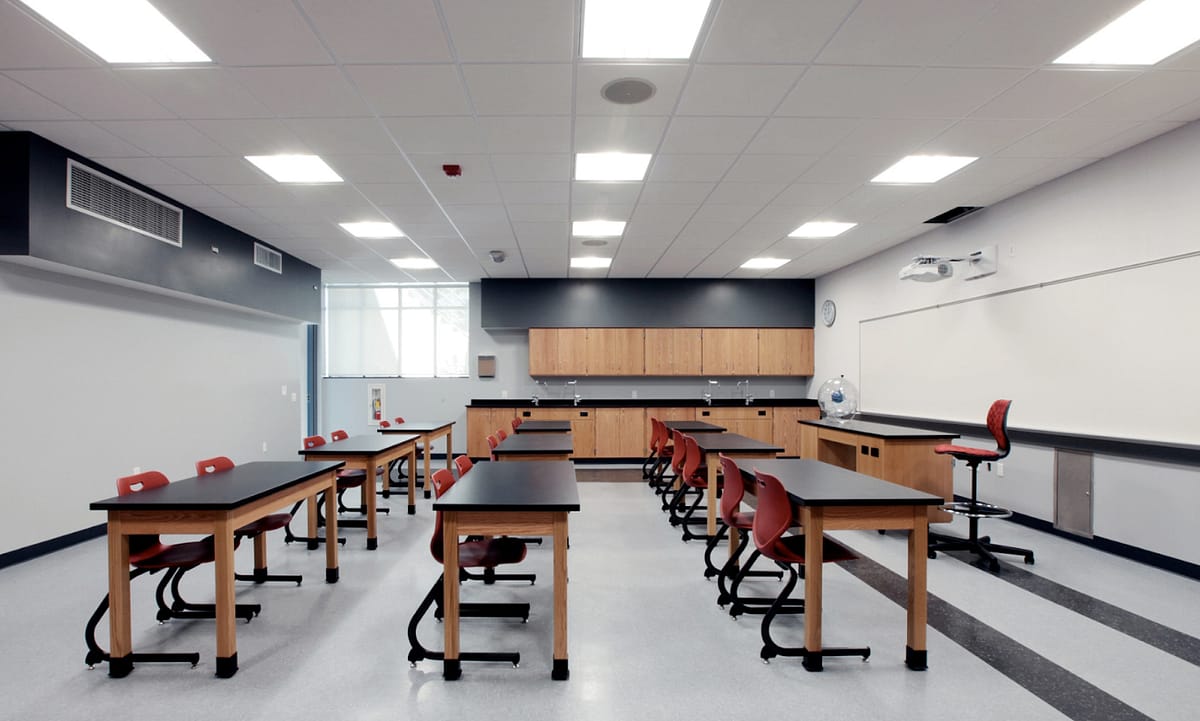
Whether in the Makerspace—which she notes as her favorite spot on campus—or the chemistry lab, Ms. Christensen encourages hands-on exploration. She appreciates the indoor-outdoor feel of campus, which allows students, teachers, and faculty to move freely between spaces and directly reflects her teaching philosophy: learning is connected to the world beyond the classroom.
Students have exciting activities to look forward to in Honors Chemistry and Algebra II—conic section paintings to illustrate the crossover of art and math, exploring math projects, acid-base fluctuation chemistry labs to make silver out of copper, and more! Ms. Christensen describes her favorite chemistry concept as anything related to quantum mechanics, specifically the behavior of electrons and light.
Mathematics became especially exciting to Ms. Christensen in high school Calculus, where limits and infinite sums piqued her interest and led her to major in math. However, her interests have a far range—from a master’s in physics, math, and acting to theater and teaching in New Orleans. She elaborates, “I get to study math and science ideas, but also be around artsy things and watch my students do many different things.”
When asked what the one takeaway from her class should be, Ms. Christensen shared her core belief of teaching which highlights the role of students not as passive observers regurgitating information, but as the future of scientific discovery: “Scientific models require creativity—they’re still unfinished, and there’s always more to discover. We don’t have all the answers, and students have a lot to offer. Anybody can do it if they put their mind to it.” And in the same way that electrons and light are both particles and waves, Ms. Christensen brings concepts to life through a blend of rigor and creativity.
![Class of 2026 Takes Part in a “[F]antastic” Game of Senior Assassins](https://mlluv3biwjhe.i.optimole.com/w:1018/h:654/q:mauto/f:best/https://theflintridgepress.com/wp-content/uploads/2026/05/Screenshot-2026-05-05-at-8.47.44-AM.png)