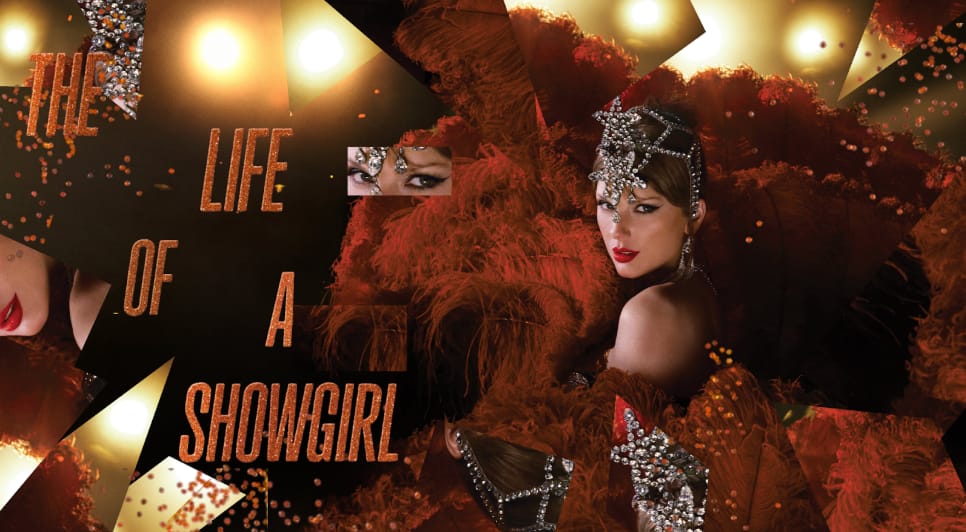
The Life of a Showgirl is possibly the most polarizing album Taylor Swift has ever released. Upon its release date in early October, fans were quick to pick sides. Some criticized its ditsy and unsophisticated raunch, others called it Trump’s “trad-wife soundtrack,” and some chose to dance along. The album’s juxtaposition of traditionalism and vulgarity acts as a mirror reflecting the current political landscape of 2025.
Critics worldwide have interpreted Swift’s new music as a shift towards white, traditional values that emphasize right-wing tendencies and lack female agency. In track 8, “Wi$h Li$t”, Swift sings, “They want that complex female character… but I just want you.” She longs for “a couple kids,” and a “driveway with a basketball hoop.” Here, Swift openly desires a white picket fence, suburban, simple life. Fans feel that these lyrics abandon the feminist persona she proudly expressed in “The Man,” and instead encourage the idea that a woman’s fulfillment stems from her male counterpart. Ammunition is given to this argument in “Wood,” a playful, Sabrina Carpenter-esque pop song. Swift hooks listeners in with sexual innuendos and a punchy beat as she writes, “his love was the key that opened my thighs.” Many have interpreted this song as a departure from previous albums like folklore, noting that she’s swapped lyrical genius for ditsy, sex-crazed trash. Swift’s simultaneous embrace of white-picket domesticity and explicit sensuality creates a fascinating, and somewhat cynical, reflection of the current Republican coalition. Within a single party coexist moral and religious conservatives who support pro-life and are champions of traditionalism, and manosphere conservatives who idolize the flashy, and vulgar charisma of figures like former reality-TV-star President Trump. Modern conservatism sanctifies traditional gender roles while celebrating profanity, and whether Swift’s inspiration was drawn from politics or her personal life, she has inadvertently crafted the perfect pop soundtrack for a culture war defined by its own blinding contradictions.
Beyond the perceived political and feminist shift, The Life of a Showgirl also ignited controversy over perceived microaggressions and potential plagiarism threats. Swift’s track “Eldest Daughter” details the relationship between an eldest child and their vulnerability, which has drawn similarities to her public life. Travis Kelce, Swift’s fiancé, had a history of dating black women up until his relationship with Taylor Swift. Many fans feel this song is a poor attempt to appeal to Gen-Z listeners through popular brainrot and slang terms. She sings, “I’m not a bad b***h, this isn’t savage”, lyrics that resemble Megan Thee Stallion’s “Savage” hit. Many critics question Swift’s intentions behind these lyrics. By explicitly denying the “bad b***h” and “savage” labels, terms that are strongly associated with Black female artists’ self-empowerment, Swift frames her superior, white woman narrative in opposition to her partner’s ex-girlfriend. However, other fans argue that there is no racial meaning behind the song, and that Swift unintentionally engaged in Black cultural aesthetics. Whether intentionally or not, social media has interpreted this song as a ballad embedded with deep racialized hierarchy. Similarly, “CANCELLED!” enters the cancel culture war, positioning Swift and her friend Blake Lively as victims of the left-wing ‘ultra-progressive’ social critique, further establishing the album’s supposed resentment towards woke culture. Another issue arises in the title track, “The Life of a Showgirl,” whose chord progression and tempo bear a striking resemblance to the Jonas Brothers’ “Cool.” Fans question whether this similarity was intentional or purely coincidental. However, fellow musicians like Charlie Puth have defended Swift, explaining copyright policy and demonstrating common chord progressions on social media to show that musical overlap doesn’t inherently indicate plagiarism.
But what is showbiz without a little backlash? In an interview for Apple Music, Swift responded to the album’s scrutiny: “I’m not the art police…What our goal is as entertainers is to be a mirror. Oftentimes, an album is a really wild way to look at yourself. What you are going through in your life is going to affect whether you relate to the music I’m putting out.” This reflection, while deemed by some as a conservative shift, anti-feminist, or even juvenile, may simply be her music’s candid reflection of her current priorities: love, happiness, and a desire for a simple, private life.
She may be accused of giggling over sex jokes or making insecure comments, but adulthood in art does not necessarily equate to conventional maturity or rising above the fray; we sure don’t see that in politics. For Swift, growing up appears to be about self-acceptance and prioritizing her own happiness, despite what the media has to say. The album’s record-breaking commercial performance affirms her approach. The Life of a Showgirl logged the largest sales week in the modern music era and dominated Billboard’s Hot 100 Chart, with all twelve tracks occupying the top twelve spots. This success proves that the album’s power lies not in intellectual subtlety, but rather in its ability to reflect the modern cultural mood by tying in catchy melodies with upbeat lyrics. While some may disagree, The Life of a Showgirl should be seen not as a regression, but rather a reflection of Taylor Swift’s modern womanhood and the complex, and often contradictory, reality of modern politics, serving as the perfect cultural time capsule for 2025.