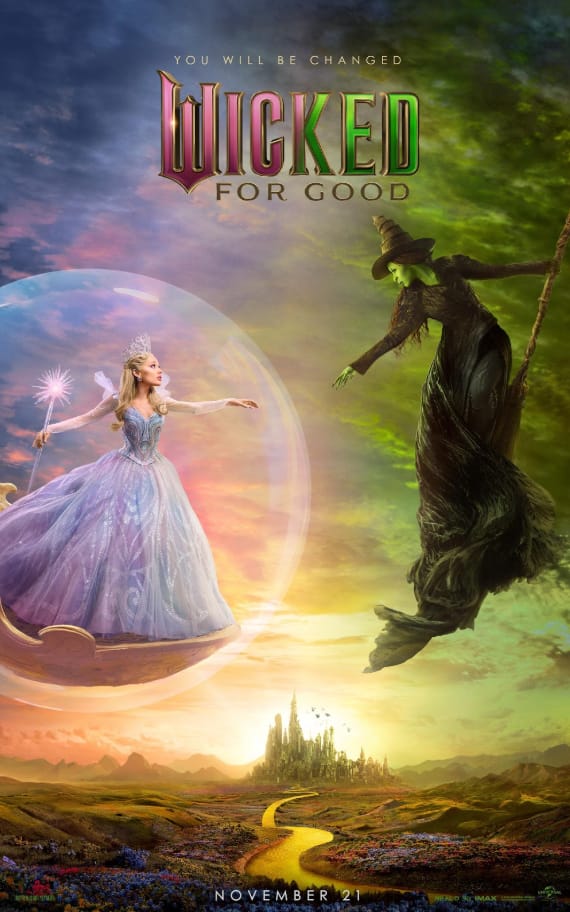
After a year of tirelessly waiting, movie and theatre fans alike were ecstatic when Wicked: For Good finally made its way to theaters in November. Grossing $226 million on its opening weekend alone, the sequel vastly surpassed its predecessor. But despite its box office success, why was Wicked all you could hear about for weeks, while Wicked: For Good withered away in just a few days, received with mixed feelings?
The obvious answer is that Wicked: For Good tried to do too much. Both movies dealt with themes such as the nature of good and evil and the scapegoating of marginalised communities. These themes were explored in the first film, leaving viewers intrigued as to how they would be resolved in the second half. However, Wicked: For Good fails to truly analyze any of them.
What Does it Mean to Be Wicked?
The first and main theme of Wicked, as the title suggests, is the fine line between good and evil—whether people are born evil or become evil. Wicked: For Good does a phenomenal job of developing Glinda, the perceived good witch, and her shift from superficial “goodness” to actual virtue, especially with the inclusion of the film-original song “Girl in the Bubble” that showcases her identity breakdown and realization of the injustices around her. However, Elphaba’s supposed “acceptance” of wickedness, meant to define that people become evil due to society, feels fake. Even the classic song “No Good Deed” seems more like a CGI flaunt rather than a deep character transformation. In the film adaptation, Elphaba never truly becomes evil like she does in the original book; she maintains her fight against the oppression of Oz and ends up doing the right thing in the end, displaying no character development from the first film and undermining the premise that people become evil due to societal hatred.
Silencing the Silenced
Wicked also fleshes out the plot point of the animals getting scapegoated by the Wizard for the problems in Oz, speaking at great length to the prejudices and oppression that exist all over the world today. People are easier to unite when a specific group is blamed for every issue, and the Wizard does just that to maintain power. Nonetheless, the animal motif succumbs to the same issue in that it gets opened up in the first film but never really closed in the sequel. The animals play a far smaller role in Wicked: For Good, reduced to helpless victims that re-enter at the end of the film like nothing happened. Instead of revealing the long-term effects of silencing a group, the film ties it all up with a bow and gives an unsatisfying fairytale ending.
Why Didn’t the Music Defy Gravity?
Furthermore, the songs in the second half are simply not as catchy, compared to “Popular,” “Dancing Through Life,” and the show-stopping number “Defying Gravity.” All of the popular and recognizable songs are in the first act of the show, and this is not the fault of the film. However, this is the direct consequence of Director John Chu’s decision to split the musical into two separate films, leading the second movie to fall short musically.
Ultimately, Wicked: For Good did an excellent job staying true to the original Broadway production, finishing up the storyline and adapting all of the key elements. However, it was simply unable to match the level of innovation, expansion, and depth of its predecessor, which gave us all the chance to defy gravity. At the end of the day, Wicked: For Good etched the Wicked franchise into all of our hearts for good.